
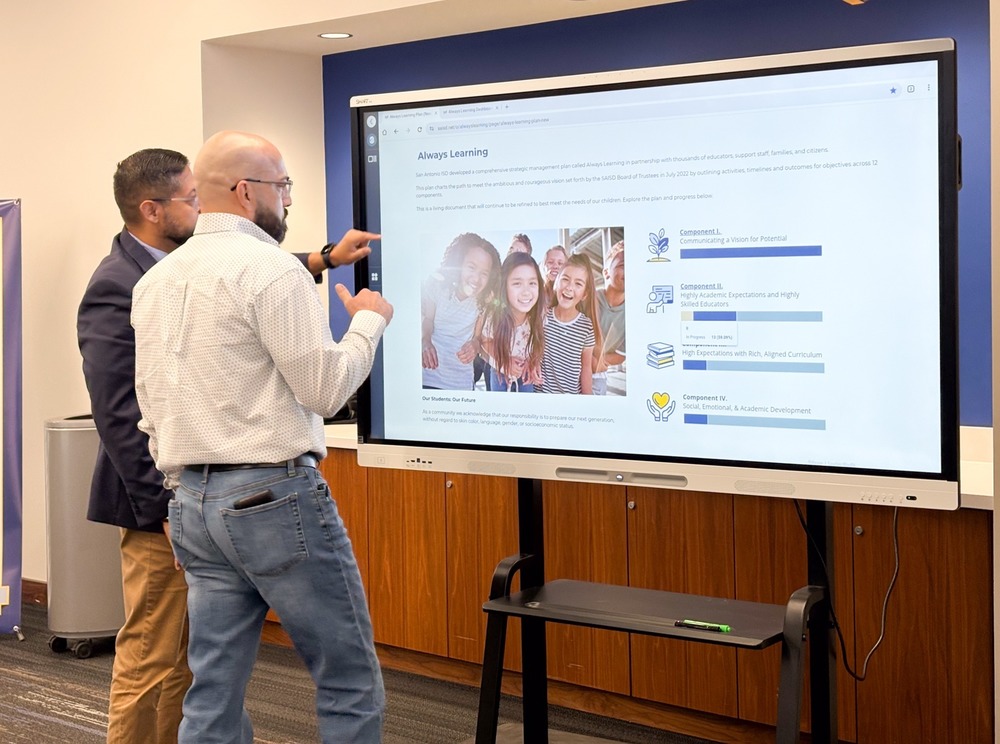
The San Antonio ISD Children’s Cabinet received a first look at the new Always Learning dashboard at their third quarter meeting last month.
At the Feb. 23 meeting, 49 cabinet members — committed families, alumni, district employees, students and community members — toured a draft of the new interactive dashboard that visualizes the progress of the 12 components in the district’s 2023 strategic management plan. They were then able to give feedback on what’s working well and what should be added to increase utility before the dashboard goes live later this semester.
The dashboard will illustrate the status and percent complete for each of 363 activities supporting 62 objectives in the plan.
“What was good was being able to showcase the Always Learning plan in a more digestible way,” parent Leslie Martinez said. “I’m excited that there are results and that we are able to showcase the progress being made. People outside the cabinet may not realize how many departments contribute data and work to the Always Learning plan and it is really great to see.”
The cabinet offered usability suggestions – including color coded keys, suggested entry points for different audience types, and utilizing photos of actual SAISD students and personnel.
Following the dashboard review, Superintendent Jaime Aquino offered the third quarter update on pairing high expectations with strong support to ensure every student succeeds.
Aquino’s presentation opened with a stark look at the district’s financial reality – despite four years of budget reductions, the district still faces a nearly $46 million structural deficit for the coming school year. The district’s goal, Aquino said, is to reduce that deficit by half in 2026-2027.
“We’re in the middle of our budget development for next school year, and budget impacts absolutely everything that we do,” Aquino said.
In preparing for this moment, over the last four years, the district has already eliminated 352 positions (75% at the district level), as part of $46 million in reductions.
“Despite all these budget reductions, we have made progress in the midst of financial challenges,” Aquino said. “Imagine if we did not have to cut that $46 million. We could potentially accelerate some of our efforts.”
In state accountability ratings, nearly two out of three district schools earned a C or better, with 30 earning an A or B rating, and 20 schools just one point away from moving a letter grade higher.
In state testing performance, district students have exceeded pre-pandemic levels in reading, and SAISD students have outpaced the state in reading, math and science in their annual levels of improvement.
In the same four-year period, student attendance has increased by three percentage points, now hovering at around 92%. And SAISD students are succeeding after they graduate, Aquino noted, with the district’s College, Career and Military Readiness score skyrocketing to 89% this past year.
Additionally, SAISD alumni are enrolling at a much higher rate in college. In 2024, 58% of SAISD graduates enrolled in college within a year of graduating. This is an 8% increase since 2021, whereas nationwide, high minority schools fell by 3% and high poverty schools dropped by 4% during the same time frame.
“His message was realistic but also giving hope,” Martinez said. “It took three to four years of work, but look what happened. When top leaders understand our students, actually see our students, we are seeing these differences.”
Aquino said as the district goes forward in budgeting for 2026-2027, the following principles will guide the process: protecting the classroom, reducing structural imbalance, investing in priority schools trying to raise their accountability scores, and making sure campus decisions are data driven, aligned with student needs, and aligned with improvement plans.
The cabinet was invited to take the SAISD Budget Priorities Survey to further inform Superintendent Aquino and the Board of Trustees as the aggressive 2026-2027 budget is created.
Deputy Superintendent Patti Salzmann briefed the cabinet on The New Way Forward, a new perspective on capital investment priorities. Salzmann showed the cabinet the assessment of all the district sites and how many would be needed to house the district’s students at campuses of ideal size. Then Salzmann illustrated that only 29 of the current sites have a facilities condition rating high enough and a footprint large enough to accommodate the level of students, especially in light of common spaces and outdoor spaces needed for modern educational sites.
"We heard loud and clear from you and other advisory councils that we should renovate when we can when it makes financial sense, and build new when we can when it makes financial sense,” Salzmann said. “We want to make a strategic shift forward that is about letting go of the idea that we are attached to buildings.”
Salzmann explained The New Way Forward involves the leveling of unoccupied buildings to make way for new construction of state-of-the-art spaces. Then, only at the conclusion of construction, could area schools be consolidated into the new space, an approach designed to minimize the disruption that comes with learning in an active renovation zone. By building first and transitioning later, students can move directly into better-resourced schools featuring innovative learning environments that reflect today’s educational standards.
The cabinet’s activities concluded with creating sample messaging around the both the district’s financial reality and The New Way Forward, challenging the district team to make it relatable to families.
“This is about as good as it can be,” parent Herb Salinas said. “We have to let everybody know and the sooner you start, the more people will find out. My overall thing is making sure everything is efficient. I think we need to be more positive. It can be frustrating, but we have to be here for our kids.”
El Gabinete de Niños ve por primera vez el tablero de información de Siempre Aprendiendo
El Gabinete de Niños del Distrito Escolar Independiente de San Antonio pudo ver por primera vez el nuevo tablero de información Siempre Aprendiendo en su reunión del tercer trimestre, celebrada el mes pasado.
En la reunión del 23 de febrero, 49 miembros del gabinete — familias comprometidas, exalumnos, empleados del distrito, estudiantes y miembros de la comunidad — recorrieron un borrador del nuevo panel interactivo que visualiza el progreso de los 12 componentes en el plan estratégico de administración del distrito 2023. Luego pudieron dar retroalimentación sobre lo que está funcionando bien y lo que debería agregarse para aumentar la utilidad antes de que el panel de control se ponga en marcha más adelante este semestre.
El tablero ilustrará el estado y el porcentaje completado de cada una de las 363 actividades que apoyan los objetivos de 62 en el plan.
“Lo que fue bueno fue poder mostrar el plan de Siempre Aprendiendo de una manera más digerible”, dijo la madre Leslie Martínez. “Estoy emocionado de que haya resultados y de que podamos mostrar el progreso que se está haciendo. Es posible que las personas fuera del gabinete no se den cuenta de cuántos departamentos aportan datos y trabajan al plan Siempre Aprendiendo, y es realmente genial verlo”.
El gabinete ofreció sugerencias de usabilidad – incluyendo teclas codificadas por colores, puntos de entrada sugeridos para diferentes tipos de audiencia, y la utilización de fotos de estudiantes y personal de SAISD reales.
Después de la revisión del tablero, el superintendente Jaime Aquino ofreció la actualización del tercer trimestre sobre cómo combinar altas expectativas con un fuerte apoyo para asegurar que cada estudiante tenga éxito.
La presentación de Aquino comenzó con un análisis realista de la situación financiera del distrito: a pesar de cuatro años de recortes presupuestarios, el distrito sigue enfrentándose a un déficit estructural de casi 46 millones de dólares para el próximo año escolar. La meta del distrito, dijo Aquino, es reducir ese déficit a la mitad en 2026-2027.
“Estamos en medio de nuestro desarrollo presupuestario para el próximo año escolar, y el presupuesto impacta absolutamente todo lo que hacemos”, dijo Aquino.
En preparación para este momento, en los últimos cuatro años, el distrito ya ha eliminado 352 puestos (75% a nivel de distrito), como parte de $46 millones en reducciones.
“A pesar de todas estas reducciones presupuestarias, hemos progresado en medio de desafíos financieros”, dijo Aquino. “Imagínense si no tuviéramos que recortar esos 46 millones de dólares. Podríamos potencialmente acelerar algunos de nuestros esfuerzos”.
En las calificaciones de rendición de cuentas estatales, casi dos de cada tres escuelas del distrito obtuvieron una calificación C o mejor, con 30 que obtuvieron una calificación A o B, y 20 escuelas a solo un punto de mover una calificación con letra más alta.
En el desempeño de las pruebas estatales, los estudiantes del distrito han excedido los niveles prepandémicos en lectura, y los estudiantes de SAISD han superado al estado en lectura, matemáticas y ciencias en sus niveles anuales de mejora.
En el mismo período de cuatro años, la asistencia de los estudiantes aumentó en tres puntos porcentuales, ahora rondando el 92%. Y los estudiantes de SAISD están teniendo éxito después de graduarse, señaló Aquino, con la puntuación de Preparación Militar, Carrera y Colegio del distrito disparándose a 89% este año pasado.
Además, los ex alumnos de SAISD se están inscribiendo a una tasa mucho más alta en la universidad. En 2024, el 58% de los graduados de SAISD se inscribieron en la universidad dentro de un año de graduarse. Esto representa un aumento del 8% desde 2021, mientras que en todo el país, las escuelas de alto nivel para minorías disminuyeron un 3% y las escuelas de alto nivel de pobreza disminuyeron un 4% durante el mismo período de tiempo.
“Su mensaje fue realista, pero también dio esperanza”, dijo Martínez. “Se necesitaron de tres a cuatro años de trabajo, pero mira lo que pasó. Cuando los líderes superiores entienden a nuestros estudiantes, en realidad ven a nuestros estudiantes, estamos viendo estas diferencias”.
Aquino dijo que a medida que el distrito avanza en el presupuesto para 2026-2027, los siguientes principios guiarán el proceso: Proteger el salón de clases, reducir el desequilibrio estructural, invertir en escuelas prioritarias tratando de aumentar sus puntajes de responsabilidad, y asegurarse de que las decisiones del campus estén basadas en datos, alineadas con las necesidades de los estudiantes y alineadas con los planes de mejora.
El gabinete fue invitado a tomar la Encuesta de Prioridades Presupuestarias de SAISD para informar más a la superintendente Aquino y a la Junta Directiva a medida que se crea el agresivo presupuesto 2026-2027.
La superintendente adjunto Patti Salzmann informó al gabinete sobre el nuevo camino hacia adelante, una nueva perspectiva sobre las prioridades de inversión de capital. Salzmann mostró al gabinete la evaluación de todos los sitios del distrito y cuántos serían necesarios para albergar a los estudiantes del distrito en campus de tamaño ideal. Entonces Salzmann ilustró que solo 29 de los sitios actuales tienen una calificación de condición de las instalaciones lo suficientemente alta y una huella lo suficientemente grande como para acomodar el nivel de los estudiantes, especialmente a la luz de los espacios comunes y los espacios al aire libre necesarios para los sitios educativos modernos.
“Escuchamos alto y claro de ustedes y de otros consejos asesores que debemos renovar cuando podamos cuando tenga sentido financiero, y construir nuevos cuando podamos cuando tenga sentido financiero”, dijo Salzmann. “Queremos hacer un cambio estratégico hacia adelante que consiste en dejar ir la idea de que estamos apegados a los edificios”.
Salzmann explicó que el nuevo camino hacia adelante implica la nivelación de edificios desocupados para dar paso a nuevas construcciones de espacios de última generación. Entonces, solo al final de la construcción, las escuelas del área podrían consolidarse en el nuevo espacio, un enfoque diseñado para minimizar la interrupción que viene con el aprendizaje en una zona de renovación activa. Al construir primero y hacer la transición después, los estudiantes pueden pasar directamente a escuelas con mejores recursos que ofrecen entornos de aprendizaje innovadores que reflejan los estándares educativos actuales.
Las actividades del gabinete concluyeron con la creación de mensajes de muestra en torno a la realidad financiera del distrito y el Nuevo Camino a Adelante, desafiando al equipo del distrito a que lo haga accesible a las familias.
“Esto es tan bueno como puede ser”, dijo el padre Herb Salinas. “Tenemos que hacerle saber a todo el mundo y cuanto antes empieces, más gente se dará cuenta. Lo que en general es asegurarme de que todo sea eficiente. Creo que debemos ser más positivos. Puede ser frustrante, pero tenemos que estar aquí para nuestros hijos”.