
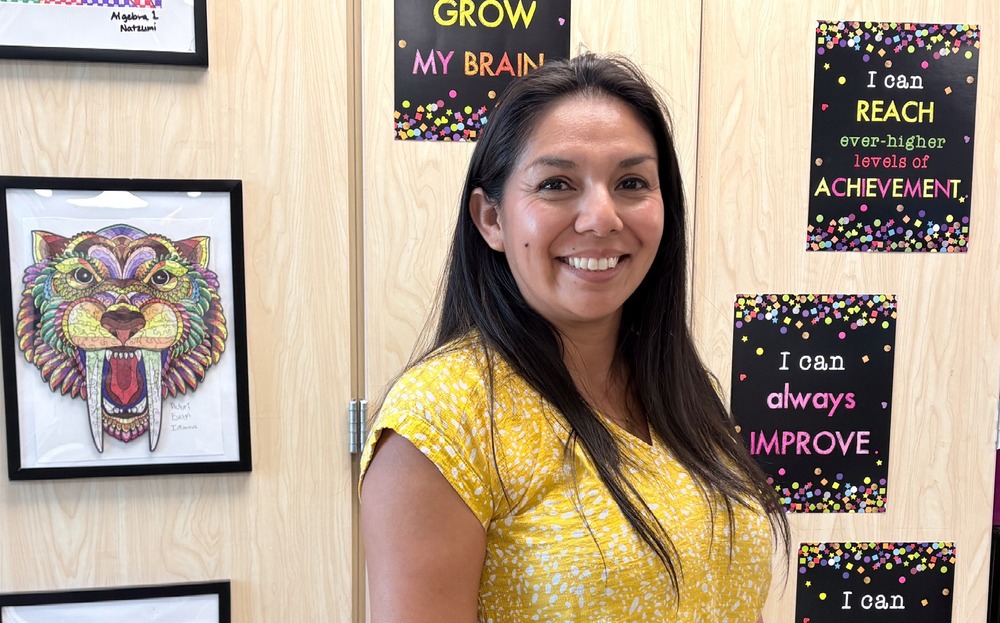
It was initially curiosity that brought Veronica Ortiz to teach high school.
The veteran middle school teacher had been teaching sixth grade math at Poe, and after a few years decided to move up with her students to learn how to prevent critical knowledge gaps. She moved from teaching sixth to seventh grade and seventh to eighth with the same group of kids, before, in an attempt to perfect her craft as an eighth-grade math teacher, she decided to followed them one last time and moved to teach at Brackenridge High School.
“I started teaching high school by accident, but on purpose,” Ortiz said. “My curiosity was whether I was getting my students ready for high school. I knew Algebra I was a big one when they got here. So my idea of coming to high school was to figure out how to teach middle school. I just followed them to see how I was doing.”
But she loved it. She loved their vocabulary, their personalities, and their ability to self-regulate.
“It’s never boring,” Ortiz said. “They are full of personality, which I love. And I like that self-regulation they have, especially as teenagers. They know when to get serious. And I like that part of it.”
It’s been nine years at Brackenridge now, all teaching Algebra I, and Ortiz’s curiosity and drive to discern data may have cracked the code on passing the STAAR End of Course exam, because last year, all her students did.
One hundred percent of them made at least approaching, 70% of them earned meets, and 33% earned masters.
“I've never had a class period at 100%, let alone every classroom,” Ortiz said. “It was really exciting.”
Her overall strategy is remarkably simple: boost her students’ confidence in math.
“They think they don't know, but they know a lot more than they believe they do,” Ortiz said. “It is getting them used to feeling successful when they've never had that before, because they've always felt like they were bad at math.”
She works tirelessly to connect her content to prior learning from middle school and even elementary school, showing them that math does not inherently have to be hard.
“I love that part of it — when they look at you and they're just like, ‘that's it, really?’ And they start to believe in themselves a little bit more,” she said.
In daily classroom activities, she is constantly evaluating her students’ progress, and more importantly, having them monitor their own. Each day, students must rate their own understanding from one to four.
“If I think you're four, but you put yourself at a one or a two, for me, that's a confidence problem that I’ve got to work with,” Ortiz said. “By the time we get to tests, I'm already predicting where I think they're going to be. And if they’re far from where I predict, then I need to jump in. But if they're where I predict, then we keep going. As long as they're making progress, then we're going in the right direction because we have all year to get them there.”
While Ortiz has 19 years of systems in place, she said it’s impossible to have the level of student success that she has had without a supportive team.
“I love the support I get from administration and the entire math department,” she said. “I'm not afraid to ask one of them to come into my room when I try something new, so that they can help me see what I don't see. What can I do different or better to help my students? At the end of the day, they want the same thing that we want as teachers. We want what's best for our kids.”
And for newer teachers, Ortiz said the biggest advice she has is to not be afraid to try those new things.
“They need to try the ideas they have, because you don't know if they're going to work unless you try them,” she said. “And when we try something new, if it doesn't work the first time that doesn't mean it won’t work at all. Sometimes it just needs to change a little bit.”
The support she has received at district schools makes that process easy.
“If you're looking at coming into teaching, I think SAISD is great,” Ortiz said. “It's the only place I've ever known and it's been very collaborative. Working together as a team has made it feel so easy, even though the work is hard some days, because you're not doing it alone.”
Fomentar la confianza en las matemáticas para lograr grandes avances en el aprendizaje
Al principio, fue la curiosidad lo que llevó a Verónica Ortiz a dar clases en la preparatoria.
Esta maestra de secundaria con experiencia había estado impartiendo clases de matemáticas en sexto grado en la escuela Poe y, al cabo de unos años, decidió pasar al siguiente grado junto con sus alumnos para aprender a evitar brechas de conocimiento importantes. Pasó de dar clase de sexto a séptimo grado y de séptimo a octavo con el mismo grupo de alumnos, hasta que, en un intento por perfeccionar su oficio como maestra de matemáticas de octavo grado, decidió acompañarlos una última vez y se trasladó a dar clases a la preparatoria Brackenridge.
«Empecé a dar clase en la preparatoria por casualidad, pero a propósito», dijo Ortiz. «Mi curiosidad era saber si estaba preparando a mis alumnos para la preparatoria. Ya sabía que Álgebra I iba a ser un tema importante cuando les tocará. Así que mi idea al enseñar en la preparatoria era averiguar cómo dar clase en la secundaria. Solo los seguí para ver cómo lo estaba haciendo».
Pero le encantó. Le encantaba su vocabulario, sus personalidades y su capacidad de autorregularse.
«Nunca es aburrido», dijo Ortiz. «Están llenos de personalidad, que me encanta. Y me gusta la autorregulación que tienen, especialmente cuando son adolescentes. Saben cuándo ponerse serios. Y eso es lo que me gusta de ellos».
Ya lleva nueve años en Brackenridge, impartiendo Álgebra I, y es posible que la curiosidad y el afán de Ortiz por analizar los datos le hayan permitido descifrar la clave para aprobar el examen STAAR de fin de curso, ya que el año pasado todos sus alumnos lo aprobaron.
El cien por ciento de ellos alcanzaron el nivel esperado, 70 % de ellos cumplieron con el estándar, y 33 % dominaron el estándar.
«Nunca había conseguido el 100% en una clase, y mucho menos en todas las clases», afirmó Ortiz. «Fue realmente emocionante».
Su estrategia general es muy sencilla: reforzar la confianza de sus alumnos en las matemáticas.
«Creen que no saben, pero saben mucho más de lo que creen», dijo Ortiz. «Se trata de que se acostumbren a sentir que tienen éxito cuando nunca antes lo habían experimentado, porque siempre habían pensado que eran malos en las matemáticas».
Trabaja incansablemente para conectar su contenido con el aprendizaje previo de la secundaria e incluso la primaria, mostrándoles que las matemáticas no tienen que ser intrínsecamente difíciles.
«Me encanta esa parte, cuando te miran y te dicen algo así como: “¿Eso es todo, en serio?” Y empiezan a creer en sí mismos un poco más», dijo.
En las actividades diarias del salón, ella está constantemente evaluando el progreso de sus alumnos, y lo que es más importante, que ellos mismos se monitoreen. Cada día, los alumnos deben evaluar su propio nivel de comprensión del uno al cuatro.
«Si yo creo que son un cuatro, pero se evalúan como un uno o un dos, para mí eso es un problema de confianza en el que tengo que trabajar», dijo Ortiz. «Para cuando lleguemos a los exámenes, ya tengo una idea de dónde creo que van a estar». Y si están lejos de donde había previsto, entonces tendré que intervenir. Pero si están donde había previsto, seguimos adelante. Mientras estén progresando, vamos por buen camino, porque tenemos todo el año para que lo consigan».
Aunque Ortiz lleva 19 años trabajando con estos sistemas, afirmó que es imposible alcanzar el nivel de éxito académico que ella ha logrado sin contar con un equipo que le brinde su apoyo.
«Me encanta el apoyo que recibo de la administración y de todo el departamento de matemáticas», dijo. «No tengo miedo de pedirle a uno de ellos que entren a mi salón cuando pruebo algo nuevo, para que puedan ayudarme a ver lo que no veo. ¿Qué puedo hacer diferente o mejor para ayudar a mis alumnos? Al final del día, quieren lo mismo que nosotros queremos como maestros. Queremos lo mejor para nuestros alumnos».
Y para los maestros más nuevos, Ortiz dijo que el mejor consejo que puede darles es que no tengan miedo de probar cosas nuevas.
«Tienen que poner a prueba las ideas que tienen, porque no saben si van a funcionar a menos que las pongan a prueba», dijo. «Y cuando intentamos algo nuevo, si no funciona la primera vez, eso no significa que no funcionará en absoluto. A veces solo hace falta cambiarlo un poco».
El apoyo que ha recibido en las escuelas del distrito facilita ese proceso.
«Si están pensando en dedicarse a la enseñanza, creo que SAISD es una opción estupenda», dijo Ortiz. «Es el único lugar que he conocido y ha sido muy colaborativo. Trabajar juntos como equipo ha hecho que se sienta muy fácil, aunque el trabajo es duro algunos días, porque no lo estás haciendo solo».