
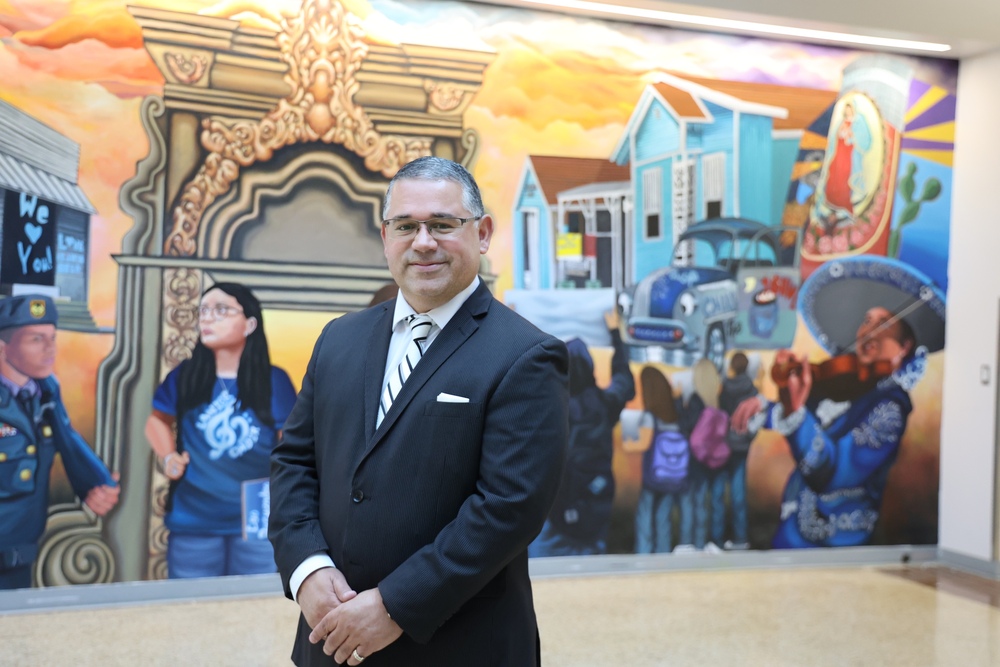
Dr. Ricky Flores was a student at Lowell Middle School the first time someone said he might be a principal someday.
The eighth grader, who grew up in the San Juan housing projects, was reeling after his parents’ separation, but found a place at Lowell in the band. Director Alfonso Villarreal had purchased a cornet for Flores to play, an instrument that shaped his identity and his future.
“Director Villarreal saw a boy with nothing to hold onto, so he handed me a purpose,” Flores said. “Knowing my family could not afford an instrument, he reached into his own pocket and bought me a cornet. He didn't just hand me a piece of brass; he handed me a voice. That cornet became my anchor through middle school, high school, and university. It became the vessel through which I poured out my pain and found my passion.”
The passion showed. So at the eighth grade awards, the principal at the time made a prediction about Flores on the center of the stage at Lowell in front of all his peers.
“This is Burbank High School’s next drum major,” his principal announced. “Ricky will be the first one in his family to go to the university. He will be the first one to become a band director. And Ricky may someday become a principal.”
Flores scoffed. At the time, he had wanted to be a police officer to escape the violence and drugs in his neighborhood.
“I wanted to drive the police car,” Flores said. “I didn’t want to be in the back seat, and where I lived, I saw a lot of people in the back seat. I wanted to be a police officer, and I wanted to help people.”
But as the years went by, a series of opportunities, mentors, and revelations in Flores’ life brought the prophesy to fruition, piece by piece.
He indeed became drum major of the Burbank Bulldog Band. In his senior year at Burbank, a counselor encouraged him to apply for a San Antonio Police Department-funded scholarship. He got it and attended Texas Lutheran University, and, though he was intending to major in sociology, the band director at TLU heard him play and offered him a full scholarship to take up a secondary major of music. He graduated from Texas Lutheran in 1995 with concurrent Bachelor of Arts degrees in Sociology and Music Education.
Mentor by mentor, and opportunity by opportunity, he made his way into music education, starting in Edgewood ISD, before getting hired as band director at Irving Middle School in 1999. Motivated by the values he received from his grandparents, he worked hard with determination while prioritizing service to his students. Success followed.
In 2001 he earned a master’s degree. In 2004, he won Texas Teacher of the Year in the H-E-B Excellence in Education Awards. In 2007 he won the Trinity Prize for Excellence in Teaching. In his 15 years in the classroom, his students received state and national recognition.
But again, a mentor told him that he could do more. He entered campus administration in 2011 as an assistant principal back at Burbank, a position that shifted his mindset from cheering students to cheering students via teachers.
“How I show up for my teachers is important,” Flores said. “I have to be their number one cheerleader because they’re the ones on the front lines doing the work. So if I support my teachers, if I take care of my teachers, they're going take care of our students.”
Flores became a principal, serving in Somerset ISD and Rhodes Middle School before coming to Lanier, serving in the same ZIP code where he lived as a child.
“There’s some unique challenges in our community,” he said. “I’m really sensitive to that because I grew up in 78207 and am coming back full circle. The experiences that I had growing up afforded me the opportunity to really connect with my students and families in a way that is unique. It gives you some street credit here because the community knows they can count on you.”
To support his teachers, students and families, Flores prioritizes being visible.
“This is a role that I take very, very seriously,” he said. “To me this is not a job, it’s a passion. It is a 24 [hours a day] 365 [days a year] position. I have to be available and I have to be visible. When you’re not, people create stories.”
During the school day, this means he and the three assistant principals at Lanier are in classrooms and hallways all day, using mobile desk carts for their computers as needed.
“Being visible in the academic spaces is a priority,” Flores said. “The paperwork will always be there. Our team does an excellent job with that. To the maximum extent we will take care of it after school.”
It also means spending time among the students. Whether it’s greeting them at dropoff, chatting with them in the halls or at lunch, Flores knows the vast majority of the school’s 1400 students, and will personally chat with them in both joyful times and when he notices a change in behavior or attendance.
“Relationships matter,” he said. “When the kids see you, it just makes a difference. Sometimes I’ll sit there with them at lunch and we’ll just connect.”
It’s a job he devotes himself to completely, while also making sure he carves out time for his family, including his wife, a district assistant principal, and four children, three of whom are aspiring educators.
It’s a full life, but one he says he would never trade.
“This has exceeded any expectations I had for myself,” Flores said. “Every word my middle school principal spoke over me has come to pass.”
For newer educators, he says it’s important they listen to mentors, but also that they tell students the potential they see in them every day.
“Never underestimate the impact and the influence that you have in the life of a young person,” Flores said. “The credit for me goes to my middle school director who took the time to invest of me. I want every kiddo here to have that same opportunity when they graduate from high school. I want them to pass by Lanier five, 10, or 15 years from now and say, ‘In that building, we had teachers that cared about us. We had administrators that cared. And I'm doing so much better because I went to Lanier.’”
Perfil del director: Flores lidera con el corazón en el código postal de su infancia
El Dr. Ricky Flores era estudiante en Lowell Middle School la primera vez que alguien dijo que podría ser director algún día.
El estudiante de octavo grado, que creció en las viviendas subsidiadas San Juan, estaba muy afectado después de la separación de sus padres, pero encontró un lugar en Lowell, en la banda de música. El director Alfonso Villarreal le había comprado una corneta a Flores para que tocara, un instrumento que moldeó su identidad y su futuro.
«El director Villarreal vio a un chico que no tenía nada a que aferrarse, así que me dio un propósito», dijo Flores. «Sabiendo que mi familia no podía pagar un instrumento, sacó dinero de su propio bolsillo y me compró una corneta. Él no solo me dio un pedazo de metal; me dio una voz. Esa corneta se convirtió en mi ancla durante la secundaria, la preparatoria y la universidad. Se convirtió en el medio a través del cual expresé mi dolor y descubrí mi pasión».
Se notaba la pasión. Así que, en la entrega de premios de 8° grado el director de entonces hizo una predicción sobre Flores en el centro del escenario de Lowell, delante de todos sus compañeros.
«Este es el próximo tambor mayor de la banda de la preparatoria Burbank High School», anunció su director. «Ricky será el primero en su familia en ir a la universidad. Será el primero en convertirse en director de banda. Y puede que Ricky algún día se convierta en director escolar».
Flores se burló. En aquel momento, quería ser policía para escapar de la violencia y las drogas de su barrio.
«Quería conducir el coche de policía», dijo Flores. «No quería estar en el asiento trasero, y donde vivía, vi a mucha gente en el asiento trasero. Quería ser oficial de policía y quería ayudar a la gente».
Pero, con el paso de los años, una serie de oportunidades, mentores y revelaciones en la vida de Flores hicieron que la profecía se hiciera realidad, poco a poco.
De hecho, se convirtió en tambor mayor de la Banda Bulldog de Burbank. En su último año en Burbank, un consejero lo animó a solicitar una beca financiada por el Departamento de Policía de San Antonio. La consiguió y asistió a la Universidad Luterana de Texas, y, aunque tenía la intención de especializarse en sociología, el director de la banda en TLU lo escuchó tocar y le ofreció una beca completa para cursar una segunda especialidad en música. Se graduó de la universidad en 1995 con una doble licenciatura en Sociología y Educación Musical.
Con la ayuda de un mentor tras otro y aprovechando una oportunidad tras otra, se abrió camino en el mundo de la educación musical, comenzando en Edgewood ISD, antes de ser contratado como director de banda en Irving Middle School en 1999. Motivado por los valores que recibió de sus abuelos, trabajó duro con determinación y priorizó el servicio a sus estudiantes. El éxito no tardó en llegar.
En 2001 obtuvo una maestría. En 2004, ganó el premio de Maestro del Año de Texas en los Premios de H-E-B a la Excelencia en Educación. En 2007 ganó el Premio Trinity a la Excelencia en la Enseñanza. Durante sus 15 años como maestro sus estudiantes obtuvieron reconocimientos a nivel estatal y nacional.
Pero de nuevo, un mentor le dijo que podía hacer más. En 2011 se incorporó a la administración del campus como subdirector en Burbank, un cargo que le llevó a cambiar su forma de pensar: pasó de animar a los estudiantes a animarlos a través de los maestros
«Es importante cómo apoyo a mis maestros», dijo Flores. «Tengo que ser su animador número uno porque ellos son los que están en primera línea haciendo el trabajo. Así que, si apoyo a mis maestros, si cuido de ellos, ellos van a cuidar de nuestros estudiantes».
Flores se convirtió en director, trabajando en Somerset ISD y en Rhodes Middle School antes de incorporarse a Lanier, ejerciendo en el mismo código postal donde vivió cuando era niño.
«En nuestra comunidad hay algunos retos únicos», afirmó. «Soy muy consciente de eso porque crecí en el 78207 y ahora vuelvo al punto de partida. Las experiencias que viví durante mi infancia me brindaron la oportunidad de realmente conectar con mis estudiantes y sus familias de una manera única. Te da cierta reputación porque la comunidad sabe que pueden contar contigo».
Para apoyar a sus maestros, estudiantes y familias, Flores da prioridad a mostrarse presente.
«Este es un papel que me tomo muy, muy en serio», dijo. «Para mí esto no es un trabajo, es una pasión. Es un puesto de 24 [horas al día] y 365 [días al año]. Tengo que estar disponible y tengo que ser visible. Cuando no lo estás, la gente se inventa historias».
Durante el día escolar, esto significa que él y los tres subdirectores de Lanier están en los salones y pasillos todo el día, usando escritorios móviles para sus computadoras según sea necesario.
«Ser visible en los espacios académicos es una prioridad», dijo Flores. «El papeleo siempre estará ahí. Nuestro equipo hace un excelente trabajo con eso. En la medida de lo posible, nos encargaremos de ello después de clases».
También significa pasar tiempo con los estudiantes. Ya sea saludándolos cuando llegan, charlando con ellos en los pasillos o en el almuerzo, Flores conoce a la gran mayoría de los 1,400 estudiantes de la escuela, y personalmente charlará con ellos tanto en momentos de alegría como cuando note algún cambio en el comportamiento o la asistencia.
«Las relaciones importan», dijo. «Cuando los niños te ven, eso marca la diferencia. A veces me siento con ellos a la hora del almuerzo y simplemente conectamos».
Es un trabajo al que se dedica por completo, aunque también se asegura de dedicar tiempo a su familia, entre la que se encuentran su esposa, una subdirectora en el distrito, y sus cuatro hijos, tres de los cuales aspiran a ser docentes.
Es una vida muy ocupada, pero dice que nunca la cambiaría por nada.
«Esto ha superado cualquier expectativa que tenía para mí», dijo Flores. «Todo lo que me dijo el director de mi secundaria se ha cumplido».
Según él, es importante que los docentes nuevos escuchen a sus mentores, pero también que les digan a los estudiantes todos los días el potencial que ven en ellos.
«Nunca subestimen el impacto y la influencia que tienen en la vida de un joven», dijo Flores. «El reconocimiento se lo debo a mi director de secundaria, que se tomó el tiempo para dedicarme su atención. Quiero que todos los niños aquí tengan la misma oportunidad cuando se gradúen de la preparatoria. Quiero que, dentro de cinco, diez o quince años, pasen por Lanier y digan: "En ese edificio teníamos maestros que se preocupaban por nosotros. Teníamos administradores que se preocupaban. Y me va mucho mejor gracias a que fui a Lanier"».